About RESIST
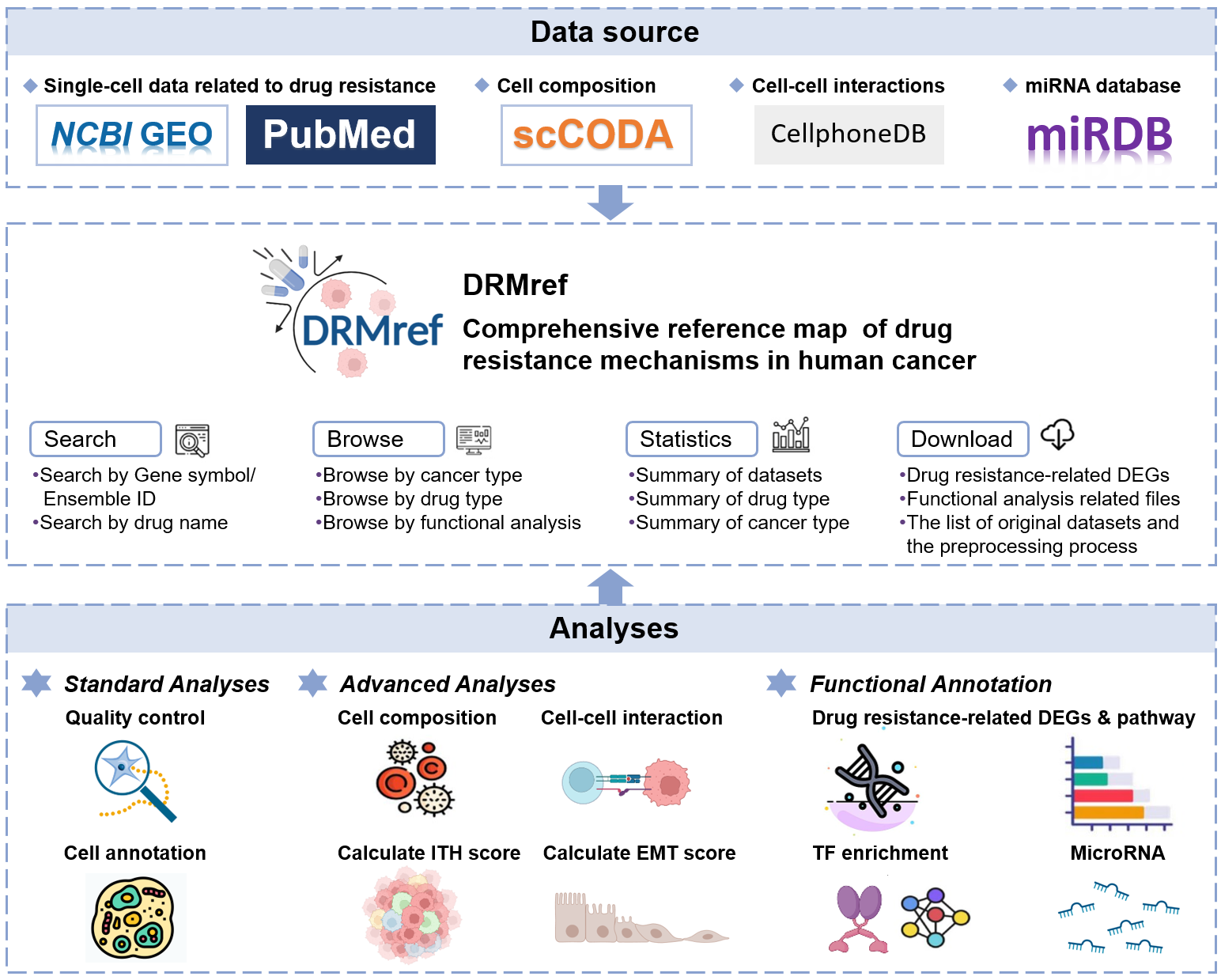
Cancer drug resistance remains a major challenge in oncology and is driven by complex regulatory mechanisms spanning genetic, transcriptional, post-transcriptional, and microenvironmental layers. Although single-cell and spatial transcriptomic technologies have enabled high-resolution characterization of resistant tumor states, systematic resources integrating these multi-layer regulatory features remain limited. Here, we present RESIST, a comprehensive resource for exploring cancer drug resistance using large-scale single-cell and spatial transcriptomic data. The current release integrates 81 single-cell RNA-seq datasets and 7 spatial transcriptomics datasets curated from 48 independent studies, comprising 522 single-cell samples and 96 spatial samples across 13 cancer types and 59 therapeutic regimens.
RESIST organizes analytical outputs into four functional modules: Characterization, Transcriptional, Regulatory, and Immunogenomic, enabling systematic investigation of resistance-associated cellular states, transcriptional programs, upstream regulatory mechanisms, and immune-related alterations. Through integrated analyses, RESIST enables identification of resistance-associated gene expression signatures, regulatory drivers including miRNAs and RNA-binding proteins, spatially resolved tumor–microenvironment interactions, and immunogenomic features such as alternative polyadenylation dynamics and intronic polyadenylation-derived neoantigens. RESIST provides a comprehensive platform for exploring molecular mechanisms of cancer drug resistance and facilitates hypothesis generation for therapeutic strategies and biomarker discovery.
Search & Browse Options
Explore our database with multiple search options for genes, drugs, diseases, and functional analysis.
Gene Search
Search by gene symbol or Ensembl ID
Drug Search
Search by drug names or browse by types
Disease Browse
Browse by cancer types and explore results
Functional Analysis
Explore DEGs, pathways, and regulatory elements
Analysis Your Customized Data
Upload your own data and generate the same comprehensive 15-section visualization analysis results as our existing dataset pages. Our analysis pipeline supports various data types and provides in-depth insights into drug resistance mechanisms.
Supported Data Types
- • Single-cell RNA sequencing
- • Spatial transcriptomics
Analysis Features
- • Characterization Module
- • Transcriptional Module
- • Regulatory Module
- • Immunogenomic Module
Copyright 2025-Present - University of Florida
